
Solving Healthcare's Anti-Counterfeiting Crisis

Solving Healthcare's Anti-Counterfeiting Crisis: Addressing the Key Concerns of Supply Chain Leaders
Counterfeit products in healthcare pose a serious threat to both patient safety and pharmaceutical supply chains. Diluted antibiotics, falsified diagnostic kits, and tampered medical devices continue to appear in distribution networks worldwide.
According to the World Health Organization (WHO), an estimated 1 in 10 medical products in low- and middle-income countries may be substandard or falsified. These risks have led regulators and pharmaceutical companies to strengthen traceability and authentication requirements across global supply chains.[who]
For compliance teams and supply chain leaders, the challenge is not simply detecting counterfeits, it is deploying solutions that work reliably in real operational environments such as hospitals, pharmacies, warehouses, and distribution centers.
When evaluating authentication technologies, organizations typically raise a number of practical concerns: Will the system remain accurate under real conditions? Can it support regulatory audits? Is it economically scalable? And will frontline teams actually use it?
The following sections address these questions based on real-world deployments and current regulatory frameworks.[pharmatrax.net]
What Is Healthcare Anti-Counterfeiting Technology?
Healthcare anti-counterfeiting technology refers to systems that verify the authenticity of medicines, medical devices, and diagnostics across global supply chains. These solutions use digital identifiers such as serialization codes or AI-based product authentication to detect falsified or tampered goods.[fdaguidelines]
By enabling regulators, distributors, healthcare providers, and, in some cases, patients themselves to confirm a product's legitimacy, these technologies strengthen pharmaceutical supply chain security and help reduce the circulation of counterfeit medical products that endanger patient safety.[who]
Can AI Authentication Work in Real-World Healthcare Environments?
Many authentication technologies demonstrate high accuracy in laboratory testing but struggle in operational settings. Variations in lighting, packaging wear, camera angles, and environmental conditions can significantly affect computer vision systems.
Cypheme's approach combines physical randomness with AI-based pattern recognition. Each Noise Print label contains microscopic patterns created during the printing process by the natural stochastic behavior of ink particles. Even when produced using the same printer and materials, each label develops a unique microstructure that acts as a physical fingerprint.
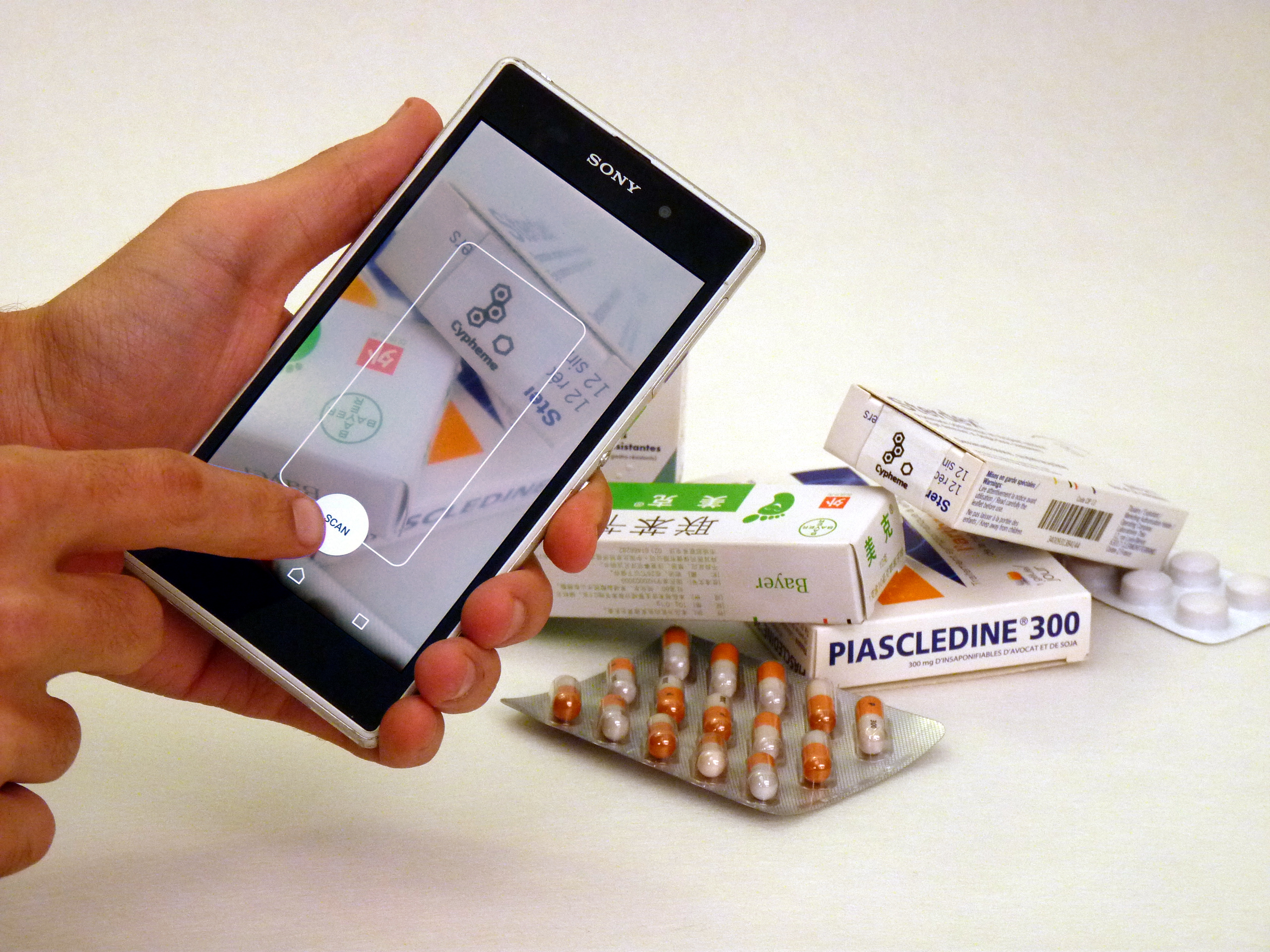
Using a smartphone camera, the Cypheme verification system captures this microstructure and analyzes more than 10,000 microscopic features from the label image. Because the models are trained on millions of real-world scans, the system is designed to maintain reliability despite lighting variations, partial occlusion, or minor packaging damage.
This authentication approach aligns with ISO 12931, which defines performance criteria for solutions designed to combat counterfeiting. Field deployments within European distribution networks have demonstrated high authentication accuracy, allowing pharmacists, inspectors, and hospital staff to verify products quickly using standard smartphones.[pmc.ncbi.nlm.nih]
How Does the Technology Support Regulatory Compliance?
Authentication solutions used in healthcare must provide more than a simple verification result, they must also produce reliable digital evidence that can support regulatory audits and investigations.
Every Cypheme authentication scan generates a secure digital record that includes:
- GPS location
- Timestamp
- Authentication result and confidence score
- Device metadata
These records create a traceable audit trail supporting compliance reporting and investigative processes.
The system is designed to complement frameworks such as the EU Falsified Medicines Directive (FMD), which prevents falsified medicines from entering the European supply chain. In the United States, similar traceability and verification requirements are outlined in the Drug Supply Chain Security Act (DSCSA), which strengthens tracking across pharmaceutical distribution networks.[optelgroup]
By generating verifiable authentication records, systems like Cypheme can help organizations identify counterfeit distribution points and support regulatory enforcement efforts.
What Is the Total Cost Compared to Other Systems?
Cost and operational complexity remain key barriers to large-scale adoption of anti-counterfeiting technologies. Many legacy solutions require specialized hardware, complex integration, or high per-unit security components, which can limit scalability across global pharmaceutical supply chains.
Cypheme takes a different approach based on secure authentication labels and smartphone verification. Authentication can be performed using standard smartphones via a secure web interface, with no dedicated readers or specialized hardware required. Authentication results are typically delivered within seconds, while more detailed forensic analysis can be performed through cloud processing when necessary.
Because the solution is designed to scale across different product lines and geographies, organizations can align deployments with risk levels and distribution priorities rather than being constrained by hardware rollout. For organizations facing counterfeit leakage or diversion, pilot programs have demonstrated strong economic potential by reducing product losses and improving supply chain visibility.[cyphemes-fight-against-counterfeiting-protecting-lives-brands-globally-dweuf.amazonaws]
Will Healthcare Professionals Actually Use the Technology?
Operational adoption is often the deciding factor in authentication success. Healthcare professionals already operate under significant time pressure, so verification tools must be extremely simple to use.
Cypheme authentication runs through a Progressive Web App (PWA) accessible directly in a smartphone browser. Users simply open the interface, scan the label, and receive an authentication result within seconds. Because the system doesn't require dedicated mobile apps or specialized hardware, it integrates smoothly into workflows in pharmacies, hospitals, and distribution centers. Field deployments have shown strong adoption rates, indicating the process fits comfortably into routine verification tasks.
Crucially, the same interface can also be used by the general public, since scanning a label with a standard smartphone is as straightforward as taking a photo. Patients are typically highly motivated to ensure that the medicines, diagnostics, or devices they use are genuine and safe, especially in more uncertain contexts such as new treatments, online purchases, or emerging market supply chains. By giving both professionals and patients an easy way to verify products in seconds, the technology helps create an additional, motivated layer of protection around every item in circulation.
Every scan also contributes valuable data, enabling organizations to map counterfeit activity and detect supply chain vulnerabilities.
Can Counterfeiters Replicate the Technology?
Traditional anti-counterfeiting tools such as holograms, QR codes, or visual security marks can sometimes be replicated once counterfeiters understand their production.
Cypheme's Noise Print technology relies on chemical randomness generated during printing, producing microscopic structures impossible to reproduce consistently. Because the AI verification engine checks for the exact micro-pattern recorded at production, even minor deviations introduced during attempted replication are detected.
Across deployments involving millions of labels, no confirmed large-scale replication attempts have been identified. This fusion of physical randomness and machine learning provides a substantial barrier against counterfeit reproduction.
Strengthening Trust Across Healthcare Supply Chains
Authentication technologies are becoming an increasingly vital part of pharmaceutical supply chain security. By combining physical security features, AI analysis, and mobile accessibility, solutions like Cypheme help verify products at multiple distribution points while generating valuable intelligence data.
Beyond counterfeit detection, authentication systems can help organizations:
- Identify counterfeit distribution hotspots
- Detect supply chain vulnerabilities
- Support regulatory enforcement
- Protect patient safety and brand integrity
Although initially developed for pharmaceutical use, similar authentication solutions are expanding across industries such as medical devices, cosmetics, electronics, and luxury goods, where product authenticity and consumer trust are critical.[Cypheme]
Evaluating Authentication Solutions Through Pilot Deployments
The most reliable way to evaluate supply chain authentication technology is through real-world pilot programs. Many organizations start with deployments covering roughly 50,000 units, allowing them to measure authentication accuracy, operational adoption, and counterfeit detection rates under true distribution conditions.
As counterfeit threats evolve, supply chain protection must evolve in parallel. Technologies that combine physical randomness, artificial intelligence, and operational simplicity offer a scalable path to strengthening trust across healthcare distribution networks.[modernod]