
What Happens When the Most Personalized Drug in History Gets Faked?
Why precision medicine's biggest vulnerability has nothing to do with the science
Cypheme · Brand Protection | Pharmaceutical Integrity
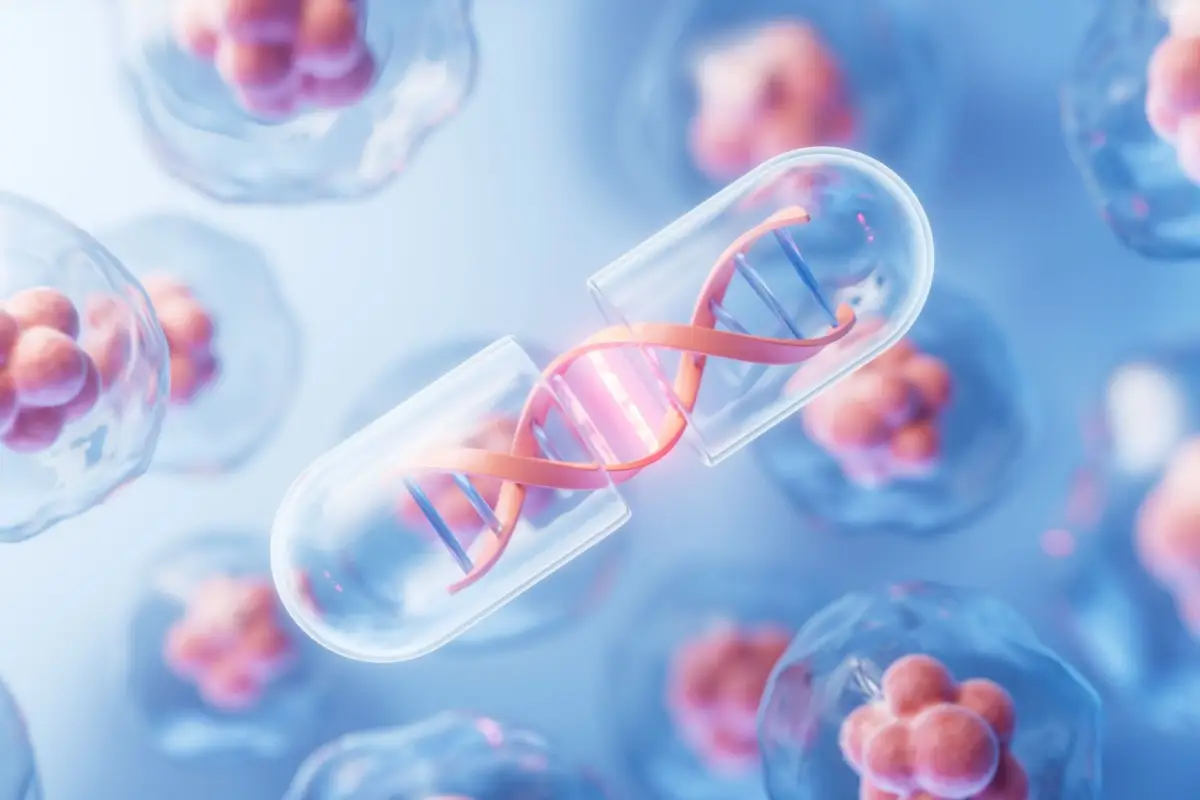
Consider what a pharmacogenomic test actually does. Before a prescription is written, a patient provides a saliva sample. The lab sequences specific variants in their drug-metabolizing genes. A report comes back telling the prescriber which antidepressants this patient will process normally, which will build up to toxic levels in their system, and which will pass through so quickly they might as well take nothing. The doctor uses that information to choose a drug. Not the drug most likely to work for the average patient. The drug most likely to work for this one.
This is pharmacogenomics, and it represents something genuinely new in medicine. Not new as in experimental. The Clinical Pharmacogenetics Implementation Consortium has published dosing guidelines for dozens of gene-drug pairs, and the FDA has embedded pharmacogenomic information into more than 300 drug labels. New as in a real departure from how prescribing has worked for the past century, where the default assumption was that drugs behave more or less the same way in more or less everyone. They do not. They never did. We just lacked the tools to see it.
The field goes by several names. Precision medicine. Personalized therapy. The label matters less than the underlying shift: a treatment decision is now, increasingly, built around a specific individual's biology.
Oncology got there first, and the evidence is hard to argue with. Patients with HER2-positive breast cancer receive therapies calibrated to their tumor's molecular identity. Patients with EGFR-mutant lung cancer receive drugs that would do little or nothing in patients without that mutation. The outcomes in both cases are not incremental improvements over previous standards of care. They are measured in years of additional life. Psychiatry is moving in the same direction more slowly, held back not by weak evidence but by the more mundane obstacles of reimbursement policy and clinical workflow. The science has been there for years. The hospitals are still catching up.
Understanding why this matters requires dwelling for a moment on the codeine case, which is old enough that it should no longer be surprising and somehow still is. Codeine is a prodrug: inert until the liver enzyme CYP2D6 converts it to morphine. That conversion is governed by a gene with significant population-level variation. Poor metabolizers get almost no conversion, therefore almost no relief. Ultra-rapid metabolizers produce morphine so fast that standard doses cause respiratory depression. There are documented pediatric deaths from normal codeine prescriptions in children who happened to carry ultra-rapid metabolizer variants. This is not a rare edge case in the pharmacogenomics literature. It is the introductory example, used precisely because it is so clear.
None of which is the point of this article. The genomics are solid. The clinical case for pharmacogenomic prescribing is not in serious dispute. What is worth examining is a problem that sits downstream of all of it, outside the laboratory and the clinic entirely, in a part of the healthcare system that precision medicine conferences almost never discuss.
The Supply Chain
According to WHO surveillance data, 1 in 10 medical products circulating in low and middle-income countries is substandard or falsified. Counterfeit and substandard medicines contribute to between 1 and 2 million deaths annually, concentrated in the markets least equipped to detect adulterated products. These numbers have been cited often enough that they risk becoming wallpaper in discussions about global health. The thing worth pausing on is what they mean specifically in the context of genomically guided therapy.
A physician prescribes a targeted kinase inhibitor because the patient's tumor carries a confirmed mutation. The dosing has been calibrated. The expected response profile is known. Somewhere between the manufacturer and the patient, a counterfeit enters the supply chain. The tablet the patient receives contains a substituted compound, or no active compound at all. It does not simply fail to treat. It occupies the treatment window. It delays the real drug. In some cases it introduces independent harm on top of the original disease. The genomic precision invested upstream has been negated by a criminal act at the point of dispensing, and the patient has no way of knowing.
Worth saying plainly: counterfeit oncology drugs are a documented, recurring phenomenon in multiple markets. This is not a hypothetical constructed to justify an argument. The problem exists and the precision medicine field has largely chosen to treat it as someone else's domain.
Most pharmaceutical companies have invested in anti-counterfeiting measures of some kind: serialization requirements, holographic labels, QR codes, tamper-evident packaging. The structural problem with most of these is that counterfeiters love them. QR codes, serial numbers, tag numbers, holograms, scratch-codes: these technologies are replicable by design, and criminals know it. They invest in mastering them, use them with confidence, and produce fakes that pass at scale. A fake product wearing a copied QR code is, from the counterfeiter's perspective, a perfectly reliable product. By the time detection catches up, the products are already in patients' hands. The intelligence gathered is also usually binary, real or fake, with nothing about where the fakes came from, through which channels they moved, or at what scale they are operating.
A Technology Counterfeiters Cannot Touch
Cypheme's Noise Print technology is built around a different model entirely. Each product receives a unique label with a chemically generated signature that functions like a fingerprint: impossible to duplicate, and with no scan limit. There is no version of this that counterfeiters can reverse-engineer. The label works the same whether it is being scanned for the first time or the fiftieth, by anyone in the chain, including the patient at the pharmacy, in under 5 seconds on a standard smartphone. No reader. No app. No IT integration. If the system identifies a product as genuine, it is genuine. If it identifies it as counterfeit, it is counterfeit.
Authenticity and Security, at Every Scan
The more consequential capability, and the part that tends to get buried, is the geolocation layer. Every scan returns precise location data regardless of whether the product is real or fake. Pharmaceutical brands and regulatory authorities do not just learn that counterfeits exist somewhere in the market. They learn exactly where they are appearing, at what frequency, and through which distribution nodes they are moving. For companies that have been fighting counterfeits reactively, without reliable origin intelligence, this changes what is operationally possible. The question stops being 'do we have a counterfeiting problem' and becomes 'here is where it is coming from, and here is the evidence to act on it.'
There is a tendency in discussions about precision medicine to treat the supply chain as an operational detail, separate from the clinical mission. That separation made reasonable sense when prescribing was largely empirical and the difference between a real pill and a fake one was primarily a commercial and safety concern. It makes considerably less sense when the prescription was constructed around a specific patient's genetic profile and the treatment window is finite.
A genome test cannot authenticate a product. A prescribing guideline cannot detect a fake at the point of dispensing. These gaps live outside the laboratory, and they will not be closed by better sequencing technology or more refined clinical protocols. They will be closed by supply chains that are held to the same standard of precision as the science they are being asked to support.
Cypheme's technology is active in more than 200 countries, has contributed to eliminating over 10 million counterfeit products, and helped recover more than 150 million euros in revenue for brands and governments. In 2025, Cypheme's Vrai AI received the United Nations AI Tech Award for demonstrated impact in the markets where this problem is most lethal. The precision medicine community has built something genuinely important. Whether the supply chains supporting it will be secured to match is, at this point, still an open question.
Is your pharmaceutical supply chain protected? Contact Cypheme today. We respond within 20 minutes, 7 days a week.
Sources:
- WHO Global Surveillance and Monitoring System for Substandard and Falsified Medical Products | who.int
- Clinical Pharmacogenetics Implementation Consortium (CPIC) | cpicpgx.org
- PharmGKB / ClinPGx Pharmacogenomics Knowledge Base | clinpgx.org
- FDA Table of Pharmacogenomic Biomarkers in Drug Labeling | fda.gov
- Pharmacogenomics: Driving Personalized Medicine | PMC / NCBI (2023)
- Integration of Pharmacogenomics into Precision Medicine | PMC (2026)
- Pharmacogenomics in Drug Therapy: Global Regulatory Guidelines | European Journal of Human Genetics (2025)
- AI and Multi-Omics in Pharmacogenomics | ScienceDirect (2025)
- Innovate UK / MHRA CERSI in Pharmacogenomics | January 2025
- Cypheme verified impact metrics | cypheme.com